
Role of Maritime Forest on Storm Wave Reduction - Sullivan's Island, SC
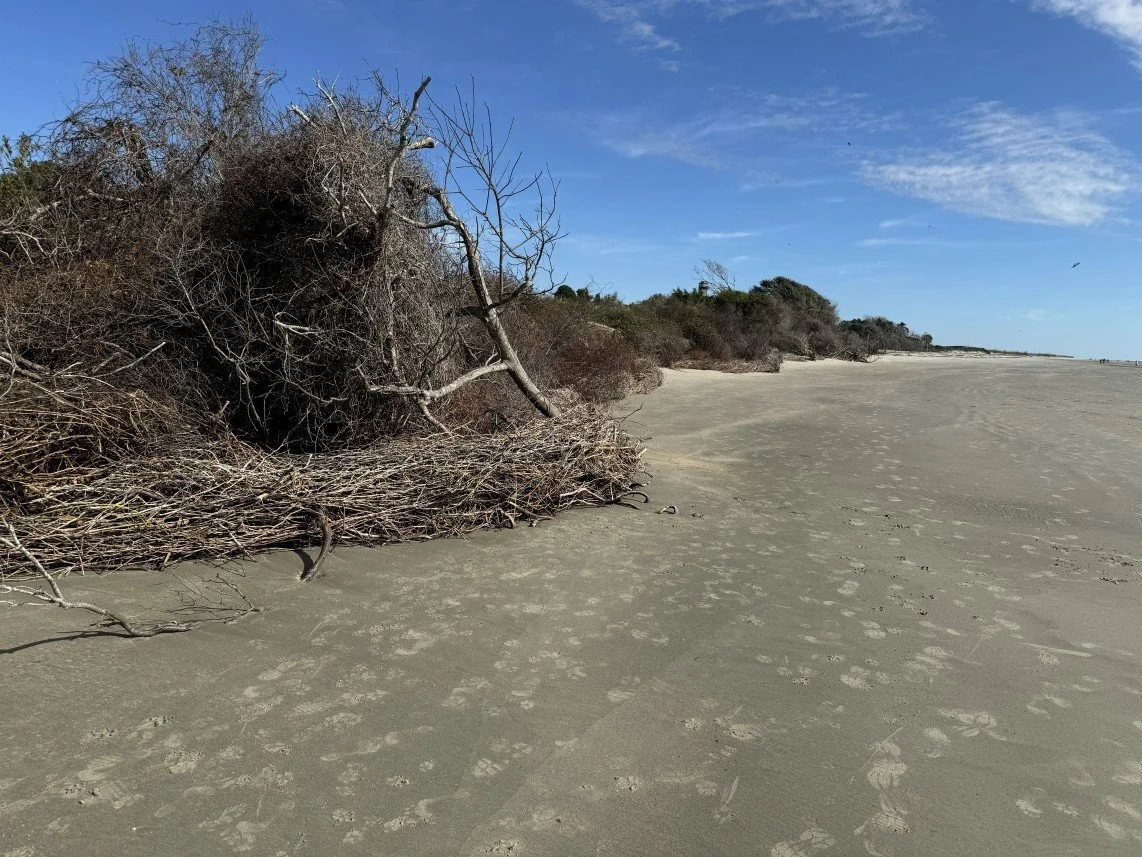
While walking on Sullivan’s Island (SI) beach recently, I noticed signs of a ghost forest on the island’s southwestern end. That observation made me think about the protective role of the maritime forest, a topic that has been debated on the island for years. Although it is widely acknowledged that the forest reduces wave energy, I had not seen a detailed analysis of its value. The emerging ghost forest also underscores how local sea level rise (SLR) is directly affecting the shoreline. This shift is occurring even though the sand supply has not declined and may have increased in recent years. There were recent beach renourishments on SI and also on Isle of Palms (IOP), which generally migrates southwest toward Sullivan’s Island. I decided to look at what kind of resilience levels trees and dunes provide.
3D structure of forest after disturbance
To look at the roles dunes and trees play in reducing waves I modeled Hurricane Hugo with and without trees and dunes under a couple of sea level scenarios. The techniques I used are provided in the report, but in short, I compared wave models run under several assumptions, including - 1) existing dunes were static during storm (very unlikely), 2) dunes evolved during storm, 3) trees were removed, and 4) trees remained at existing levels. A ‘roughness factor’ for different vegetation types and conditions was used to model the reduction of waves from the different conditions.
The quick summary is that trees are, where present along SI, almost as big of a factor in reducing large storm waves as are dunes. The two are important in different ways, dunes are the first line of defense and can provide significant protection until they are either eroded or inundated. Once either of these processes occurs the dunes are no longer protecting the interior of the island. This is when trees, the second line of defense, become the main aspects of inland resilience. Trees will fall over, twist, bend, etc., but that is what makes them so effective at reducing waves. The two are opposites – intact dunes are excellent wave reducers but not when scoured out, trees are much less effective at reducing waves when upright, but when toppled and combined with other types of vegetation they become very effective at reducing waves.
Resilience is maximized when there are multiple backstops – each working in tandem naturally. Dunes help trees to grow by protecting them from the wind and spray and trees subsequently help stabilize dunes with their roots. For us, together they form a dual protection scheme that many other islands, such as IOP, do not have. Once the dunes on IOP are eroded or inundated the waves are unimpeded and will create much more damage. It’s a natural system we on SI are lucky to have.
If interested in seeing the whole report, you can get it here